Updated: Jul 29
And What the Industry Is Finally Starting to Understand
Every organization we talk to has the same story. They spent the last two years deploying AI tools — Copilot, ChatGPT Enterprise, a handful of point solutions, maybe an early agentic workflow or two. There was excitement. There were demos. There were slides about transformation.
And then, quietly, most of it stopped working.
Not all at once. Not with a dramatic failure. More of a slow drift: answers that were almost right, recommendations nobody trusted, automations that ran but whose outputs the team still reviewed manually before acting on. The AI was technically functioning. The business wasn't actually changing.
It wasn't the AI's fault. And it probably wasn't yours either.
The problem runs deeper than the tools. It runs all the way down to the foundation — to the question of what your AI agents actually know about your business, how reliably they know it, and what governs their behavior when they act on it.
We wrote about the role of the data foundation back in our January 2026 edition:
The Problem Nobody Is Saying Out Loud
Here is the uncomfortable reality of most enterprise AI deployments today: every conversation starts from zero.
Your AI tools are intelligent. They are capable of remarkable reasoning, synthesis, and generation. But when your employee opens a chat window and asks "what drove margin compression last quarter?", the AI has no idea what "margin" means in your context, which data source is authoritative for that answer, which version of the revenue model is current, or whether the person asking is allowed to see that information at all.
It makes something up. It sounds confident. It might even be close. But it is synthesizing from whatever it can find, without knowing what it doesn't know, and without any governed understanding of your business to anchor its reasoning.
This is not a failure of AI capability. It is a failure of infrastructure — specifically, the absence of a shared, governed, continuously updated context layer that AI agents can actually reason from.
The 2025 wave of AI deployment gave agents access to data. What it did not give them was understanding. And the difference between those two things is the difference between an AI that helps your business and one that generates plausible-sounding noise at scale.

Why Context Is the Real Problem?
Think about what it takes for a human expert to do good work at your company. They don't just need access to your systems. They need to understand what your data means — what "customer" versus "client" refers to, which table is the source of truth for a given metric, where the PII lives, which policies govern what they can share with whom. They need institutional knowledge: the kind that lives in people's heads and in the norms built up over years of operation.
This context is what makes human judgment trustworthy. And it is exactly what AI agents lack.
When you deploy an agent into a fragmented data environment — a CRM with stale fields, a warehouse with undocumented tables, PII scattered across untagged columns, pipelines that break silently, schemas that drifted from their documentation six months ago — you are asking that agent to synthesize chaos. It finds things. It is confidently wrong about many of them. The company brain you thought you were building turns out to be a hallucination engine with excellent UX.
This is not hypothetical. It is what is happening at the majority of enterprises right now. The challenge is not whether to deploy AI. It is whether the data foundation underneath that AI has been made trustworthy enough to reason from.
The organizations that answer that question seriously will pull ahead. The ones that keep piling agents on top of ungoverned data will keep wondering why their AI investments aren't delivering.
What Gartner Is Telling Us (And Why It Matters)?
On May 2026, Gartner released an important prediction: by 2027, 40% of enterprises will demote or decommission autonomous AI agents due to governance failures identified only after production incidents occur.

The root cause, according to Gartner, is not that AI agents are inherently dangerous. It is that organizations are applying governance as a binary — either locked down or fully trusted — without calibrating control to the actual autonomy level and trust boundary of each agent.
Gartner describes four autonomy levels for AI agents, each requiring distinct governance:
Level 1 — Observe: Read-only access, outputs visible only to the requesting user. Use cases: summarization, retrieval, explanation. Governance priority: scoped data access, authentication, usage logging.
Level 2 — Advise: Agents generate recommendations and drafts; humans execute all decisions manually. Governance priority: accuracy testing, hallucination detection, user training on appropriate reliance.
Level 3 — Act with Approval: Agents execute actions — writing data, sending communications — but only after explicit human approval. Governance priority: meaningful approval workflows, audit trails, incident response.
Level 4 — Act Autonomously: Agents execute independently within guardrails; humans review exceptions and aggregated outcomes. Governance priority: continuous monitoring, enforced guardrails, rollback mechanisms, clear ownership.
The pattern Gartner identifies in organizations that fail is consistent: governance is treated as documentation rather than infrastructure. Policies exist on paper, but they are not embedded into runtime systems. There are no enforced guardrails in production. No one has defined who owns each agent through its full lifecycle — from development through deployment through retirement. And when a production incident occurs, the gap between what the governance policy said and what the agent actually did becomes visible — and consequential.
The Gartner framing makes something important explicit: AI governance is not a compliance checkbox. It is an operational requirement. And it must scale alongside the autonomy of the systems it governs.
What Governance Actually Means in Practice?
The word "governance" gets used in a lot of different ways, so it is worth being precise.
In the AI context, governance is the system of controls, policies, and accountability structures that determine how AI agents access data, make decisions, take actions, and are held accountable for outcomes. It answers questions like: Who is allowed to see this data? What is the authoritative source for this metric? Which agent is permitted to write to this system, and under what conditions? Who owns this agent's behavior in production? What happens when something goes wrong?
Governance is not just about restriction. It is about enabling AI to operate at scale with the trust of the people and organizations that depend on it.
In practice, good governance has several components:
Data access control — role-based permissions enforced at the data layer, not as a UI checkbox but as a hard constraint on what any agent or user can retrieve.
Lineage and auditability — the ability to trace every data point back to its source, understand how it was transformed, and explain why an AI reached the conclusion it did.
Data contracts — explicit, enforced agreements about what a data asset means, who owns it, and what quality standards it must meet before downstream systems can consume it.
PII classification — automated tagging of sensitive fields at ingestion, so privacy obligations travel with the data wherever it goes.
Policy enforcement — business and compliance rules that are embedded into workflows, not maintained separately in documents that agents cannot read.
The key word in all of these is "enforced." Governance that lives in a PDF is not governance. Governance that is embedded into the data layer — so that no agent, no query, no workflow can bypass it — is governance that actually holds.
What a Context Intelligence Layer Is, and Why Agents Need It?
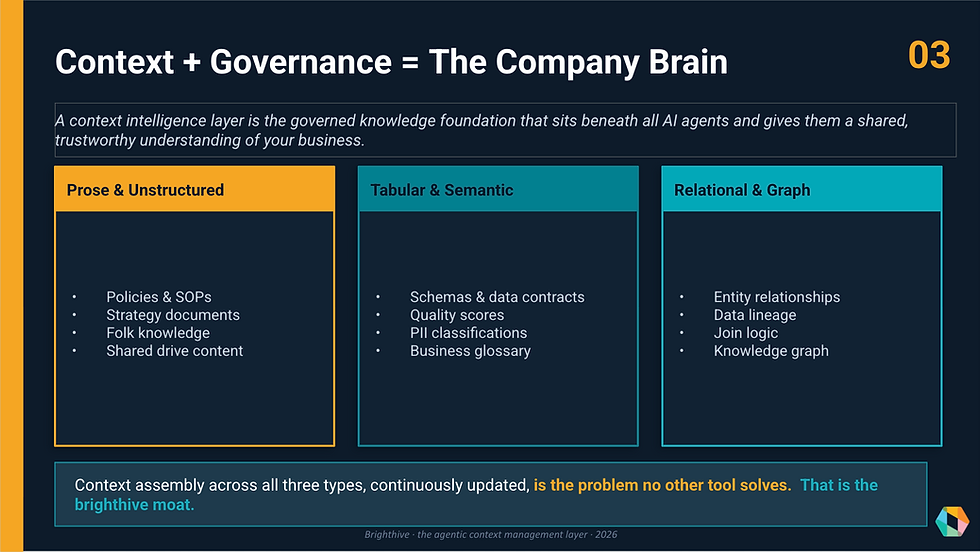
A context intelligence layer is the managed, governed knowledge foundation that sits beneath your AI agents and gives them a shared, trustworthy understanding of your business.
It is not a static data catalog. It is not a one-time cleanup project. It is a continuously operating system that assembles, maintains, and updates the three types of context that agents actually need to do real work:
Prose and unstructured context — your policies, strategy documents, SOPs, folk knowledge, institutional memory. The things that used to live only in the heads of your most experienced people and in shared drives nobody could find.
Tabular and semantic context — your structured data: schemas, data contracts, quality scores, PII classifications, business glossary definitions. The layer that ensures "customer" means the same thing in your CRM, your warehouse, and your analytics pipeline.
Relational and graph context — the entity relationships, data lineage, join logic, and knowledge graph that allow an agent to understand not just what a data point says but how it connects to everything else in your data environment.
Context assembly across all three of these types, continuously updated and governed, is what most enterprises are missing. And it is precisely what makes the difference between an AI agent that confidently hallucinates and one that knows what it knows, knows what it doesn't, and can be held accountable for its reasoning.
When agents can draw on a governed context layer, they behave differently. Their answers are grounded. Their confidence is calibrated. Their actions are traceable. And when something goes wrong — which it eventually will — the audit trail exists to understand why and fix it.
What a Company Brain Is, and How Context and Governance Build It Over Time?
The "company brain" is a phrase you are hearing more often now. At its core, it refers to a system that gives your organization a persistent, compounding, role-appropriate understanding of itself — one that is accessible to every AI agent and every person who needs it.
The concept is right. The execution is mostly wrong.
Most company brain implementations are built from the top down: deploy a reasoning layer, connect it to your data, and hope the intelligence emerges. The problem is that intelligence is only as good as what it reasons from. A company brain built on unclean, undocumented, inconsistently governed data does not accumulate understanding. It accumulates hallucinations. The more it runs, the more confidently wrong it gets.
A real company brain is built from the bottom up. It starts at ingestion — before any reasoning layer ever touches the data — and builds a clean, governed, semantically rich foundation that gets stronger with every passing day.
This is where context and governance converge to create something that compounds.
Every new data source onboarded with active profiling and schema detection adds to the semantic layer. Every quality test authored and executed raises the confidence floor across everything that depends on that data. Every data contract enforced tightens the definition of what data means and who can use it. Every lineage relationship captured makes the knowledge graph more complete. Every policy embedded into a workflow means one fewer compliance gap.
Day 30 looks qualitatively different from Day 1. Not because the AI got smarter — but because the foundation got more trustworthy. And a company brain that compounds on a trustworthy foundation is one that actually delivers on the promise: a CFO getting a governed, role-appropriate answer to a margin question without filing a ticket; a compliance officer seeing policy enforcement happen at the data layer automatically; a new hire accessing institutional knowledge that used to walk out the door with senior people.
The moat this creates is not the technology. It is accumulated, irreversible organizational intelligence. The gap between an organization that started building in January and one that starts in July is not six months. It is six months of compounding that cannot be bought or shortcut.
The Brighthive Approach: The Agentic Context Management Layer

This is the problem Brighthive was designed to solve — not from the top down, starting with intelligence and hoping the data catches up, but from the bottom up, starting at ingestion and building the governed context foundation that makes a trustworthy company brain possible.
Brighthive is the agentic context management layer at the center of your enterprise AI. It assembles, governs, and continuously updates the structured, semantic, and unstructured context that makes every AI agent in your business trustworthy, accurate, and explainable — from day one.
Here is how it works.
Seven specialized agents, one orchestrator. Brighthive's platform is built around seven agents, each with a distinct responsibility in the data lifecycle, all coordinated by BrightAgent — the supervisor that interprets requests, determines which agents to deploy, sequences their work, and synthesizes their outputs. BrightAgent lives in your Slack or Teams, learns your workflows through persistent memory, and serves as the single conversational interface to your entire data stack.
The Ingestion Agent connects to 600+ platforms and brings data in with active profiling and schema detection from first contact. Every new source arrives with a quality baseline already established — not inferred later when problems have already propagated downstream.
The Quality Agent runs continuously — not at checkpoint moments — writing and executing quality test suites, flagging stale fields, scoring severity, and proposing fixes before bad data reaches anything downstream. It does not wait to be asked. It is always running.
The Governance Agent auto-tags PII at ingestion, enforces data contracts across every workflow, and maintains attribute-level lineage so every agent in your ecosystem always knows not just what a data point says but how authoritative it is, who owns it, and what rules govern its use. Governance is not a review step at the end. It travels with the data from the moment it enters your environment.
The Engineering Agent transforms governed data into consistently modeled, version-controlled structures — so "closed deal" means the same thing across your revenue model, your CRM integration, and your analytics pipeline. Schema drift stops being a silent killer.
The Analysis Agent surfaces cross-source patterns that do not exist in any single system — the kind of insight that previously required a skilled data analyst to recognize and synthesize manually.
The Visualization Agent produces outputs only after every preceding quality and governance gate has cleared. A dashboard built on unvalidated data never reaches the user.

Context assembly across three types. What makes Brighthive uniquely positioned is not any single agent. It is the assembly of all three context types — prose/unstructured, tabular/semantic, and relational/graph — into a single, continuously updated foundation. No other platform does this. Most tools handle one type. Some handle two. Assembling all three, with governance traveling through all of them, is the problem nobody else is solving.
Deployed inside your infrastructure. Brighthive deploys inside the customer's own infrastructure with a zero-copy architecture — Snowflake, Databricks, BigQuery, Redshift, Azure. Your data never leaves your environment. Initial setup takes hours. Customers immediately get a measure of their context health through a Context Health Score — an objective, board-presentable measure of AI readiness that tracks knowledge graph completeness, metadata coverage, data quality, governance policy coverage, NLQ accuracy, and context freshness.
The context API and MCP. For organizations with existing agent orchestrators and AI tooling, Brighthive exposes a governed context API and a context MCP that any third-party agent can plug into. When your Cortex agents, your Copilot workflows, or your custom-built AI systems connect through this interface, they inherit the compliance rules, the policy enforcement, and the governed context that Brighthive maintains. You do not need to rebuild your existing AI stack. You give it a foundation it can trust.
Compliance built in, not bolted on. Brighthive is SOC 2 Type II, HIPAA, GDPR, and ISO 42001 certified. For regulated industries — financial services, healthcare, insurance, government — this is not a nice-to-have. It is the prerequisite for deploying AI at all.
Connecting It Back: What This Means for the Gartner Prediction?
Return to Gartner's finding: 40% of autonomous AI agents will be demoted or decommissioned by 2027 due to governance failures.
The failure mode Gartner describes is an organization that treats governance as documentation — policies in PDFs, frameworks in decks — rather than as operational infrastructure embedded into the systems where AI actually runs.
The context intelligence layer is what closes that gap.
When governance is embedded into the data layer — when PII is tagged at ingestion, data contracts are enforced in every workflow, lineage is tracked from source to consumption, and every agent interaction is auditable — governance stops being a policy document and starts being a live system. It is not checked at review time. It is enforced continuously.
This is also how you implement Gartner's proportional governance model in practice. An agent operating at Level 1 draws on context that has been scoped to read-only, role-appropriate data. An agent operating at Level 4 autonomously executes against a governed foundation where every action leaves an audit trail, every data source has a known quality score and ownership chain, and every compliance rule has been enforced before the agent ever touches the data. The proportionality Gartner recommends does not come from a governance framework alone. It comes from a context layer sophisticated enough to enforce different rules for different agents across different trust boundaries — automatically, continuously, at scale.
The Window Is Open Now
The company brain category is being defined right now. There is no dominant standard. There is no established infrastructure layer that enterprises have converged on.
The organizations that move first — that build the agentic context layer now, that start accumulating governed, compounding organizational intelligence today — will hold a position in 2027 that cannot be bought later. Six months of compounding context is not something you can shortcut. You either have it or you don't.
The industry spent 2025 giving agents access to data. 2026 is about making that data trustworthy enough to reason from.
That is what Brighthive is for.

What is Brighthive?
Brighthive is the world's first fully agentic data team. A governed AI workforce that mirrors the structure of a human data engineering organization. It's built around BrightAgent, a supervisor that orchestrates six specialist agents (Ingestion, Quality, Governance, Engineering, Analysis, and Visualization) across a company's entire data stack, from ingestion to insight.
80% of data work is "grunt work": broken ingestion, undetected quality decay, governance that's documented but never enforced, and brittle pipelines needing constant babysitting. Broken ingestion, undetected quality decay, governance that's documented but never enforced, and brittle pipelines needing constant babysitting. Brighthive's agents handle that grunt work autonomously and continuously, so human data teams can focus on judgment, strategy, and AI readiness instead of plumbing.
It's deployed as a single-tenant environment inside a customer's own cloud (AWS, Azure, or GCP). There is no data egress, and it connects to whatever stack they already run (Snowflake, Databricks, Redshift, BigQuery, dbt, etc.) rather than requiring a rip-and-replace. It's SOC 2, HIPAA, GDPR, and ISO 42001 compliant.


Comments